Clinical Roadmap: Lumbar Fusion Surgery (Post-Operative Rehabilitation)
Lumbar fusion rehabilitation is not a checklist of exercises, it is a progression of clinical decisions. The goal with this specific surgery is to restore function, strength, and confidence in movement while a bony fusion is healing and maturing. Unlike decompression procedures, lumbar fusion requires clinicians to respect biological healing timelines while progressively rebuilding load tolerance, hip strength, and trunk control.
This roadmap follows a simple framework I use for all of my patients:
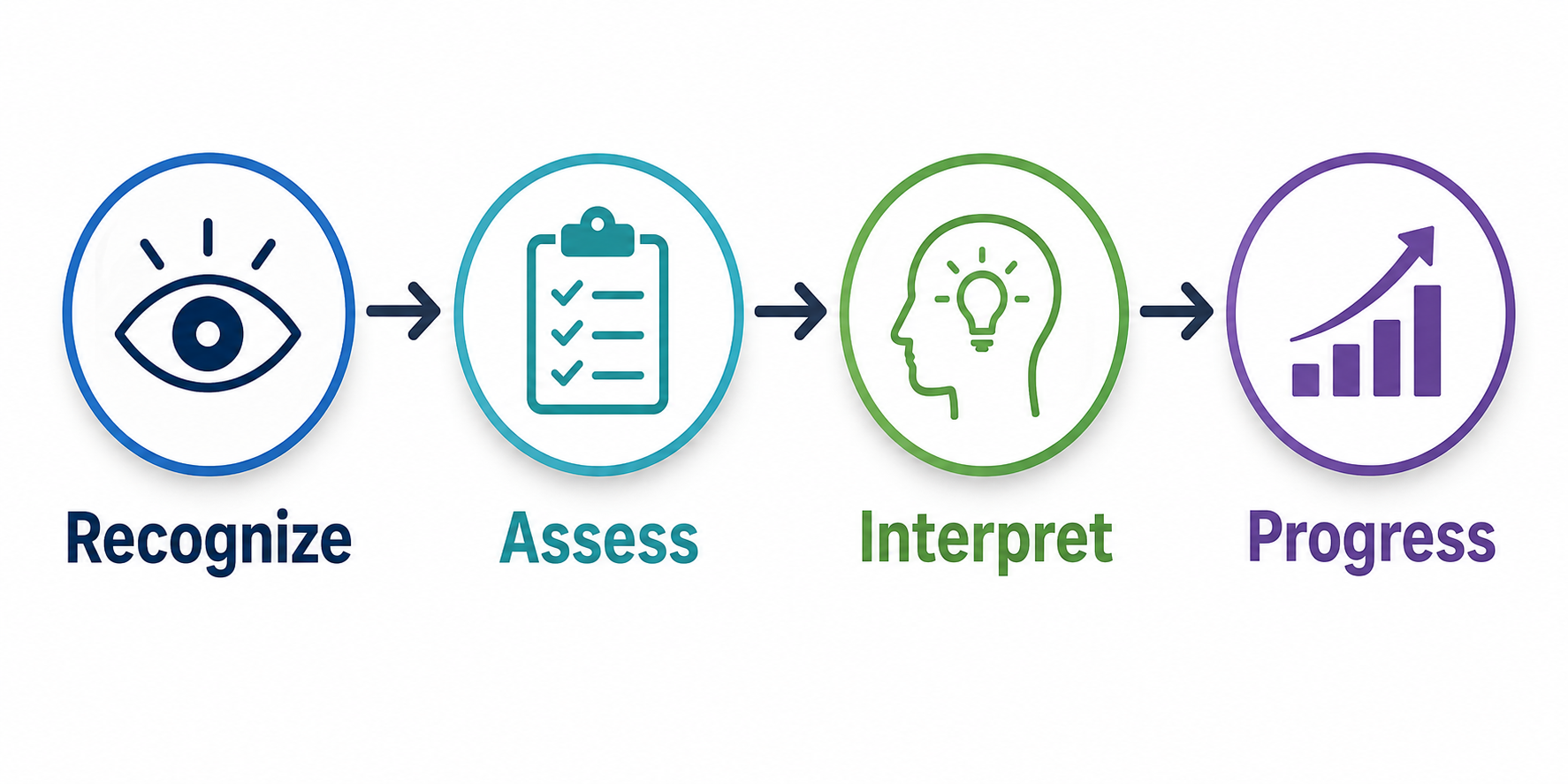
Instead of asking “What exercise comes next?”, the better clinical question is: “Is this patient ready for more load through the spine?”
Clinical Snapshot: Recognize It
Lumbar fusion is most commonly performed for:
Degenerative spondylolisthesis
Lumbar instability
Degenerative disc disease with mechanical pain
Recurrent disc herniation with instability
Degenerative scoliosis
Chronic low back pain unresponsive to conservative care
Common procedures include:
TLIF (Transforaminal Lumbar Interbody Fusion)
PLIF (Posterior Lumbar Interbody Fusion)
ALIF (Anterior Lumbar Interbody Fusion)
LLIF/XLIF (Lateral Lumbar Interbody Fusion)
Posterolateral fusion
A typical post-operative presentation consists of:
Incisional low back pain
Guarded movement patterns
Reduced trunk mobility (by design)
Hip and core weakness
Decreased walking tolerance
General deconditioning
Fear of movement or reinjury
Early rehabilitation is not about restoring spinal motion. It is about restoring safe movement, load tolerance, hip-driven strength, and functional movement confidence.
Clinical Examination: Assess It
The purpose of the evaluation is not to “test everything,” but to determine: Is the patient healing as expected, and can we safely progress loading? Taking a thorough history is the first step. Here are the things I always want to know:
Date of surgery
Levels fused
Surgical approach
Surgeon-specific precautions
Brace and lifting restrictions
Concomitant procedures
This is where the plan begins to become very individualized. These are the subjective findings that matter most:
Pain trend (improving vs worsening)
Leg symptoms (resolving vs persistent)
Walking tolerance
Sitting and standing tolerance
Confidence with movement
Activity response after therapy sessions
Fear avoidance behaviors
During your initial evaluation, depending on the stage of recovery, these may be some of your objective priorities. Always start with function first including:
Bed mobility
Sit-to-stand quality
Walking tolerance
Stair negotiation
Transfer mechanics
Next assess movement quality such as neutral spine control, compensation patterns, and hip vs lumbar dominance. Then you can move on to strength progressively and depending on what your patient can handle on day one. Assess strength in the hips (glutes), core control (anti-movement strategies), and lower extremity strength deficits.
Clinical Reasoning: Interpret It
Lumbar fusion rehab typically fails in one of two ways:
Too much protection → deconditioning
Too much loading → symptom flare or delayed healing
Your job is to find the balance based on healing stage, symptom response, movement quality, and functional movement tolerance.
Key Pattern Recognition
Physical therapy is a lot of pattern recognition. You need to be familiar enough with certain diagnoses and procedures to know what is normal rehab progression, what is likely normal for a specific patient with other comorbidities, or when it is time to refer back to the surgical team. With a lumbar fusion consider the following:
Improving pain + improving walking tolerance → Normal recovery
Pain improves but endurance remains low → Deconditioning (not pathology)
Increasing mechanical pain with activity spikes → Load intolerance → temporarily regress
Persistent or worsening leg symptoms → Reassess neural involvement or surgical factors
Common Challenges
The biggest challenge these patients often face is fear of movement. Most of the time their back has been an issue for quite some time or they have had some sort of trauma, which lead to their surgery. This is understandable. The key is to let patients succeed as much as possible in rehab. These are some common challenges patients will have to work through:
Fear of movement
Overprotection
Weak gluteal system
Poor trunk endurance
Hip compensation patterns
Deconditioning from inactivity
Red flags (Do Not Miss)
Any of these new or worsening symptoms warrant referral back to the surgical team or emergency medicine:
New bowel or bladder dysfunction
Saddle anesthesia
Progressive neurological weakness
Fever or wound drainage
Suspected DVT
Sudden severe loss of function
Important note: Every time I have sent a patient to the ER, I have a fear of being wrong and the issue being nothing, but it is better to be safe than sorry. I have caught a few DVTs in my day and the patients are always grateful in the end (even if they really, really don’t want to go to the ER)!
Rehabilitation Roadmap: Progress It
Progression is not determined by time alone. It is determined by healing, symptoms, movement quality, and functional tolerance.
Phase 1: Protection (0–6 weeks)
Goals for this phase include protecting the fusion, promoting safe mobility, controling pain, and preventing deconditioning.
Key Interventions:
Frequent walking (short bouts throughout the day)
Log rolling and bed mobility training
Sit-to-stand mechanics
Glute sets, quad sets, ankle pumps
Abdominal bracing (light, controlled)
Clinical Focus:this phase is about movement reintroduction, not strengthening.
Progress when:
Incision is healing
Pain is stable or improving
Independent basic mobility is achieved
Walking tolerance is increasing
Phase 2: Early Mobility (6–12 weeks)
Goals for this phase include improving endurance, restoring hip strength, building trunk control, and normalizing movement patterns.
Key Interventions:
Bridges
Clamshells
Side-lying hip abduction
Sit-to-stand progressions
Step-ups
Pallof press (light resistance)
Bird dog (short lever)
Walking progression
Stationary bike
Clinical focus:This is the shift from movement tolerance → load tolerance
Phase 3: Progressive Strengthening (12 weeks–6 months)
Goals for this phase include restoring strength, improving lifting mechanics, building work capacity, and increasing functional independence.
Key Interventions:
Goblet squat (light → moderate)
Romanian deadlift progression
Split squats
Step-downs
Hip thrusts
Carries
Cable rows and pulldowns
Anti-rotation progressions
Clinical focus: This phase is where patients are often underloaded. The priority is restoring confidence in controlled spinal loading through the hips.
Phase 4: Return to Function (6–12+ months)
Goals for this phase include returning to work and recreation, restoring full functional capacity, and building long-term resilience.
Key Interventions:
Loaded squats and hinges
Functional lifting patterns
Carry variations
Sport/work simulation
Conditioning progression
Return-to-running (if cleared)
Clinical focus: The question becomes: Can the patient tolerate real-world demands consistently?
Clinical Progression Ladder
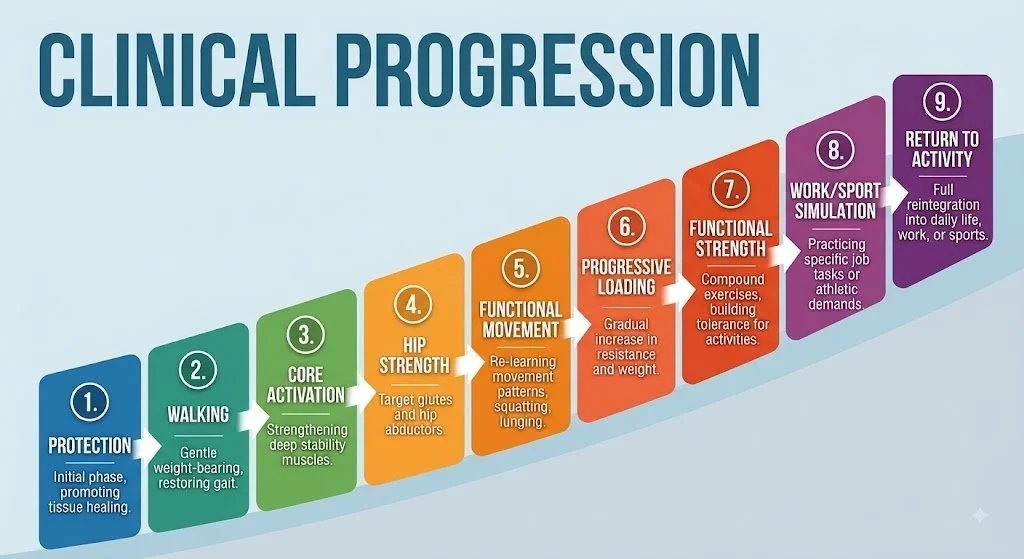
Key Milestones for Post-Op Lumbar Fusion Rehabilitation
Incision healed
Pain controlled
Independent walking
Normalized transfers
Functional hip strength
Tolerates progressive loading
Returns to ADLs
Returns to work
Returns to recreation (if appropriate)
Common Student and New Clinician Mistakes
Treating fusion like a low back strain.
Progressing trunk loading too early.
Avoiding hip strengthening.
Over-restricting long-term movement.
Using time instead of function to guide progression.
Clinical Takeaway
Lumbar fusion rehabilitation is not about restoring spinal motion. It is about restoring trust in movement under load. The clinician’s role is to progressively rebuild movement confidence, hip-driven strength, trunk control, and functional capacity while respecting the biology of fusion healing.
As always, remember to be patient with your patients. This is a major surgery that requires time to heal. For some of your patients it could be absolutely life-changing. Join them along for the journey, don’t judge them for being scared.
-Your Friendly Neighborhood CI
Key References
George SZ, Fritz JM, Silfies SP, Schneider MJ, et al. Interventions for the Management of Acute and Chronic Low Back Pain: Revision 2021. J Orthop Sports Phys Ther. 2021;51(11):CPG1–CPG60.
McGregor AH, Probyn K, Cro S, et al. Rehabilitation Following Surgery for Lumbar Spinal Stenosis: A Cochrane Review. Spine. 2014;39(13):1044–1054.
Resnick DK, Choudhri TF, Dailey AT, et al. Guidelines for the Performance of Fusion Procedures for Degenerative Disease of the Lumbar Spine (Parts 1–14). J Neurosurg Spine. 2005;2(6):637–738.
Educational Disclaimer
This guide is intended as an educational resource for healthcare professionals and students. It should not replace clinical judgment, surgeon-specific protocols, individualized patient care, or postoperative precautions provided by the operating surgeon. Rehabilitation should always be progressed based on biological healing, objective findings, patient response, and surgeon recommendations rather than time alone.
Continue Building Your Clinical Reasoning
Enjoyed this Clinical Roadmap?
Explore more evidence-based guides designed to help physical therapy students and new graduates build clinical reasoning, not just memorize diagnoses. From common orthopedic conditions to post-operative rehabilitation and exercise prescription, each Clinical Roadmap is designed to help you think like a clinician and become more confident in the clinic.
New Clinical Roadmaps are added regularly as the Thinking Clinically library continues to grow.
Movement doesn't have to be complicated.
Building your exercise knowledge takes time. Explore the
Thinking Clinically YouTube exercise library for simple, practical exercise
demonstrations to help you build your clinical knowledge and understand, choose,
and teach exercises with confidence.
